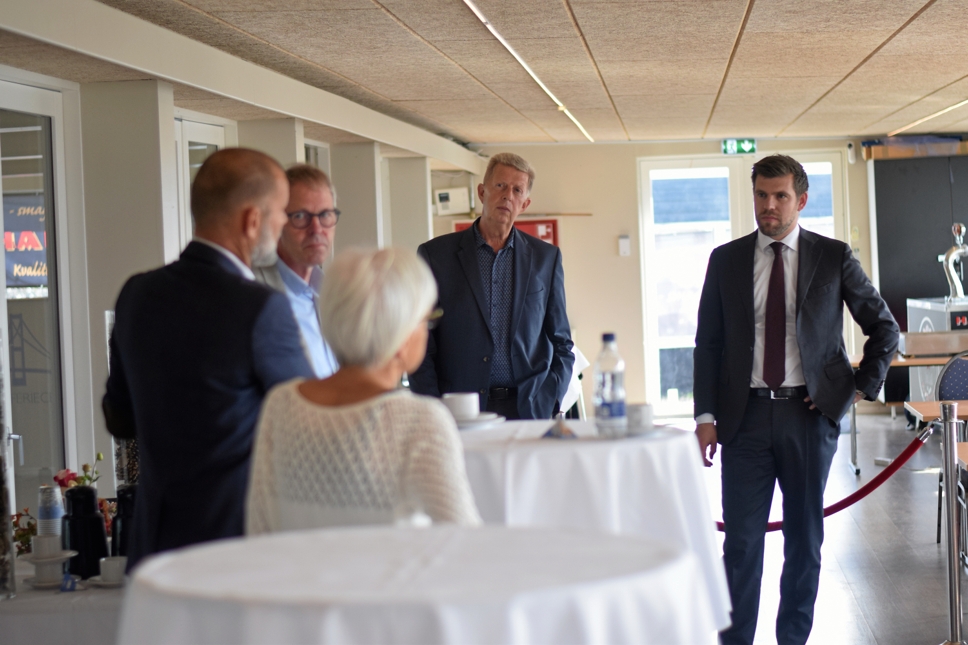

There was a strong turnout at Storebælt Camping, one of West Zealand's leading campsites, when tourism development in the region took centre stage on 10 September 2025. Local and national stakeholders gathered to discuss how new government funding could strengthen the area and unlock its significant tourism potential.
Tourism on the agenda in Korsør
With the 2025 Finance Act, the Danish government has allocated 200 million kroner for new tourism initiatives across Denmark. Six million of this is earmarked for Zealand, and particularly West Zealand, where Storebælt Camping is centrally located.
Denmark's Minister for Rural Affairs and Ecclesiastical Affairs, Morten Dahlin (Venstre), visited the campsite to underline the importance of collaboration between the municipalities and Destination Sjælland. He emphasised that the goal is to attract more tourists and create local growth through investment in capacity, experiences and infrastructure.
Rising guest demand
At Storebælt Camping, there's a clear sense of growing interest in nature-close accommodation at a campsite in West Zealand. Guests from Germany, Norway and Sweden feature especially prominently in the statistics. According to Morten Jensen, director of Destination Sjælland, demand has grown year on year, but capacity is struggling to keep pace.
"We're seeing more people wanting to experience the coast, the sea and the local attractions. That's why investment is needed, so we can match demand," he explained during the visit.
Storebælt Camping as an example
It's no coincidence that this particular campsite in West Zealand was chosen as the setting for the visit. The site is a popular base for tourists wanting to combine beach, culture and nature in a single stay. With its proximity to Trelleborg, Skælskør and the harbour towns of Korsør, the campsite is a fitting example of the potential the region holds – see more experiences nearby.
The Mayor of Slagelse Municipality, Knud Vincents (Venstre), pointed to exactly these local strengths: "We have a number of attractions and unique places in the municipality. With the new funding, we have the opportunity to draw even more visitors to the area," he said.
A national strategy with local impact
The tourism development funding is part of a broader national effort supporting cross-municipal development plans. For Zealand and its surrounding islands, the development plan was launched in 2020 with the ambition of unlocking the region's tourism potential.
Since then, the number of overnight stays has risen markedly – from 4.8 million in 2020 to 5.4 million in 2024 – and tourism revenue has grown to 16.4 billion kroner. Even so, West Zealand still holds untapped potential. Of the 66 million overnight stays recorded in Denmark in 2024, only 924,000 took place in the West Zealand municipalities.
A focus on capacity and complete experiences
At the meeting at Storebælt Camping, capacity was highlighted as a key challenge. Campsites and other nature-close accommodations are seeing rising occupancy, but sustaining growth will require more beds.
Morten Jensen from Destination Sjælland also pointed to the need to develop a cohesive experience offering: "We need to make sure guests get a complete experience. Nature is important, but we also need to offer culture, activities and lively towns."
Tourism as a local growth engine
For the minister, the visit to Storebælt Camping was an opportunity to underline that tourism is also a political priority. He stressed that the investments should both create jobs and ensure Denmark remains attractive to foreign visitors in the future.
"When we succeed in attracting more tourists, we also create new jobs and development in local communities," said Morten Dahlin.
Storebælt Camping in the plan for the future
With an update to the development plan for Zealand and its islands due in 2026, it's clear that campsites like Storebælt Camping have an important role to play in the future of West Zealand as a whole. Here, the tourism strategy's goals of more overnight stays and higher quality connect directly with the concrete experiences guests find in the region.
The visit demonstrated how national strategy and local reality are linked. And at the centre of it all stood Storebælt Camping, a living example that tourism isn't just about figures and plans – it's about experiences that create memories and value for both guests and the local community.
Read more about the regional tourism initiative on the Destination Sjælland website.